

Divine Intervention
Divine Intervention
The past and future of vintage fashion brought together by a market stall crucifix.
Alexander McQueen modeled by Hannah Rose and photographed by Steven Raj Bhaskaran of Matière Fécale for Byronesque. Interview with Simon Costin, friend and creative inspiration to Lee McQueen and creator of the AW 1996 Dante mask, by Byronesque.
Credit: Alexander McQueen Dante Mask AW 1996 by Simon Costin. Model Hannah Rose, Matière Fécale.
Filmed by Milos Mihajluv.
Derek Jarman
I’m Simon Costin. I trained as a set designer however, I’ve also done art direction, catwalk shows, shop design and interiors. I also have another hat as a curator and director of two museums. So, there are these two disciplines that I have. There’s the design work, which is more commercial and then there’s the museum work which is more academic.
I got into the fashion industry purely by accident. I never intended to get into it, but whilst I was at college I made, I suppose you’d call it bodies, sculpture really, it wasn’t necessarily jewelry as such, although you could wear it.
When I went to art school, we were set a mask making project by Derek Jarman, the film director, who was a part time tutor at college in the early ‘80s. This mask making project was about the power of masks as a means for becoming something other. So not only just a disguise, but symbolically changing who you were, be it an animal, another person or whatever it might be. I chose to use taxidermy techniques that I used at college. This developed and grew into a series of body pieces that I used to make to go clubbing in basically. Clubs like The Mudd club, The Batcave. It was the new Romantic era. And later on, of course, there was Kinky Gerlinky, Taboo. I knew Leigh Bowery. I’m a seventh generation Londoner you see. I just grew up in London in that scene.
I was on a tube one morning wearing a piece of my jewelry with a claw. I remember that it was rush hour and it caught on the back of a jacket of the woman in front of me. And she turned out to be the head buyer Liberty’s. And she said, Why the hell is that? Ultimately, she asked me to bring some things in to show her. I was squatting at the time, because you could squat back then, with a group of artists. I went in to see her and she commissioned a range of pieces. And this grew into a kind of practice. I started making the jewelry full time and then developing narratives around each one. And as they grew more elaborate, the press got ahold of it. And there were some articles in The Face and I-D and little interviews and stuff like that.
“What was iconic about the crucifix masks is that they looked great in photos. They look fantastic. They're a very stark, striking, simple image. And they carry a degree of outrage, which of course, Lee loved”
Fashion Fugitive And Tilda Swinton
And as the work developed, I was approached by a gallery on Cork Street, which is no longer there called the Silver Gallery, designed by Nigel Coates who asked me to do a range of jewelry. I ended up doing a radio show. I was kind of blurry eyed and I took a few pieces along to explain what the collection was about. And one of them was a piece called The Incubus necklace. And the Incubus necklace was, again based on that clash between early Christian beliefs and Celtic and it looked at the way that the early church had to find excuses for the misdemeanors of priests and nuns basically nuns when they became pregnant and priests when they were discovered to be doing whatever they were doing. So, it was a piece about hypocrisy in a way and it featured five vials of human sperm in little bottles.
The BBC received so many complaints that they notified the police. And the next day the gallery rang me because I was due to take everything in to be displayed in the cases at noon, to tell me that the police were there with a warrant for my arrest for public indecency because of the radio interview. And the next morning press headline was Scotland Yard to act on sick show in town. I thought I had suddenly slipped into some kind of alternative reality. It was just the weirdest thing. So, I had to find somewhere to hide with all the work while the legal people tried to work out what the hell was going on. But they did raid my studio, much to the consternation of all the artists who were frantically hiding whatever illegal substances they may have had in their rooms.
Meanwhile, the show was being opened by my friend, Tilda Swinton, who was at the time, just starting out in her career, as we all were, until it was due to open the show. And luckily, legally, if somebody pretended, they bought the necklace, and it was private property we could go ahead. Anyway, it opened, and I sold everything, and that necklace is now in the permanent collection of the MET in New York.
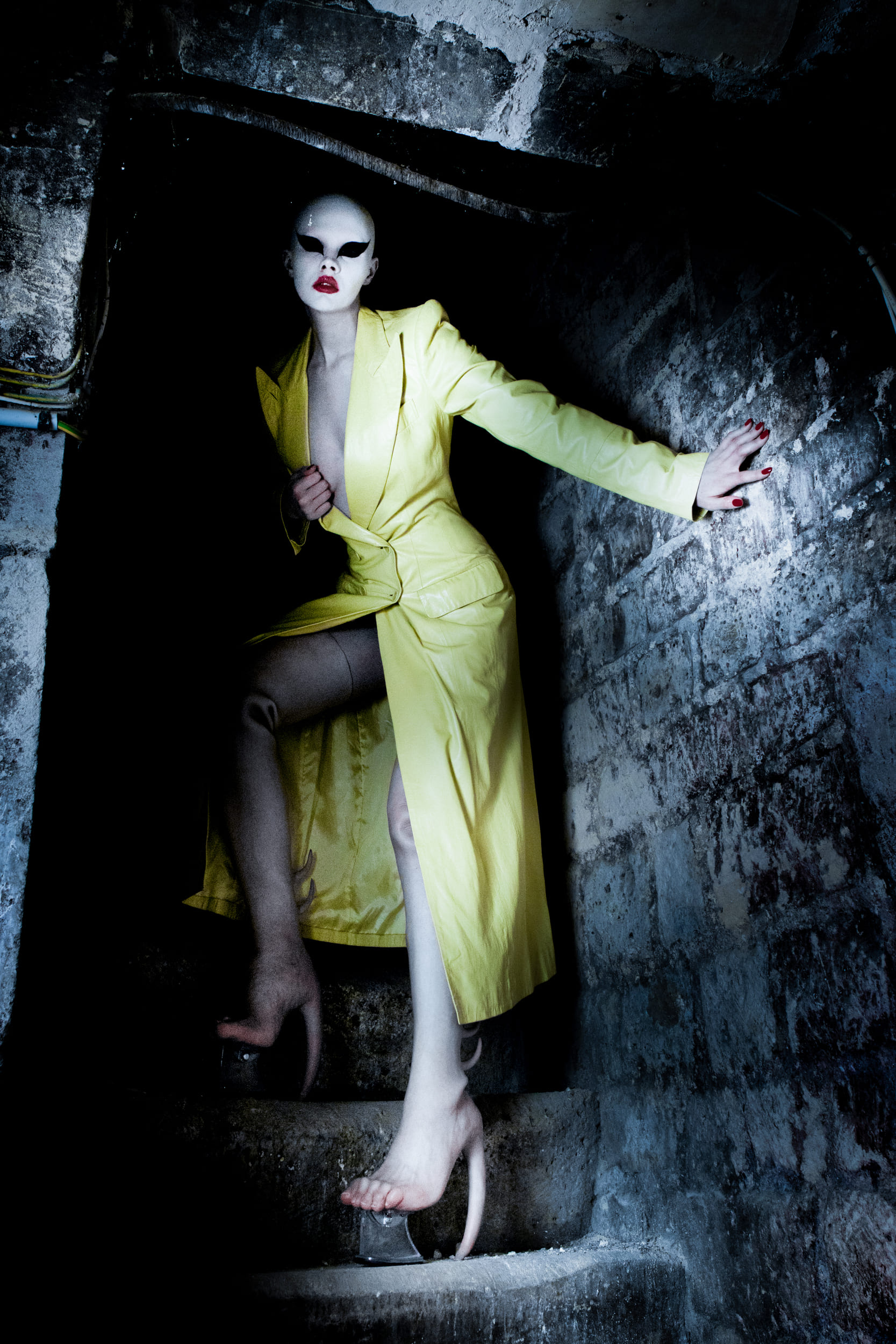
Hannah Rose Dalton in Alexander McQueen Golden Shower AW 1998
Paris
Lee saw an article about this whole debacle, and he wrote me a letter asking if I was still making jewelry and that he wanted to borrow some things for his degree show. I didn’t know who he was, no one knew who he was, because he was still a student at Central Saint Martin’s. I went to the college on the day of the show, and he just put my things on the models. We hung out and we ended up becoming friends.
Lee was very open minded to ideas, but we didn’t have a penny, I mean, the first thing I did was The Birds show and I think I just painted a road stripe down the middle of the catwalk and put some black screens up and bits and pieces. We didn’t get the venue till the last minute, so I think it was the day before I was nailing up some black cloth and putting some flats. Everything was done on a shoestring. And you know, the shows got more complex. And then Amex came in and there was more funding, and then of course Lee got the Givenchy job, and we all went to Paris.
Dante
Dante was the first show that I wasn’t directly involved with the set, because there wasn’t a set, it was held in the Christ Church in Spitalfields, and it was practically derelict back then. There were holes in the floor that we had to put boards across, and the models were in a freezing cold room at the back. I created the horns headwear, and of course, the masks. My memories are mainly to do with setting up the front of house. I remember models were walking and going back to get changed and somebody else would put the same mask on and walk onto the runway. Several models wore the same mask.
“He’d say ‘great thanks’ Simona, as he used to call me. And then we went to the pub, and then his ex turned up, they had a row and he left.”
Making Fashion History
Back then we had no idea that any of this would become as significant as it has become. We were living in the moment. We weren’t for one minute thinking of what would be happening 30 years down the line. And bear in mind those masks weren’t original. They were based on Joel- Peter Witkin’s self-portrait. I’d recently had exhibited work in Milan with Joel in a group show of artworks that were to do with the body. I met him at the private view, and we got on like a house on fire. And we actually ended up seeing each other when he came to London. I’ve lost touch with him now. But I gave Lee the catalog from the show because Lee had never heard of him. That’s very much what I felt my role was, to bring things to Lee.
Because Lee was so enveloped in designing and developing the collections, I always thought, Oh, I know Lee would like this. So, it was a very holistic working process, we would all feed in stuff that may get thrown out or may get used. I think the Witkin’s catalog struck a chord with Lee. And because we were showing in Christchurch, he said “can you knock me up some of those masks, yeah?”. Along with some assistants back at the squat, we found a selection of crucifixes which were sourced from all over the place. And they were basically pulled off wooden crucifixes that we found. I remember we found some on Brick Lane in a junk shop. Bear in mind, eBay didn’t exist then, so we were sourcing things from car boot sales and junk shops.
And because of this, each mask is in of itself one-of-a-kind. For instance, one didn’t get used in the show, because Jesus’ feet hung too low on the model’s face. So, we had to source figures which were the right size, and then work out a way of sticking them onto the masks.
There would have been about a dozen masks made I think, but after the show, a couple of models left with some because they were going to a party, and I know one got dropped and smashed. There are seven in circulation, and only 5 left, that I know of.
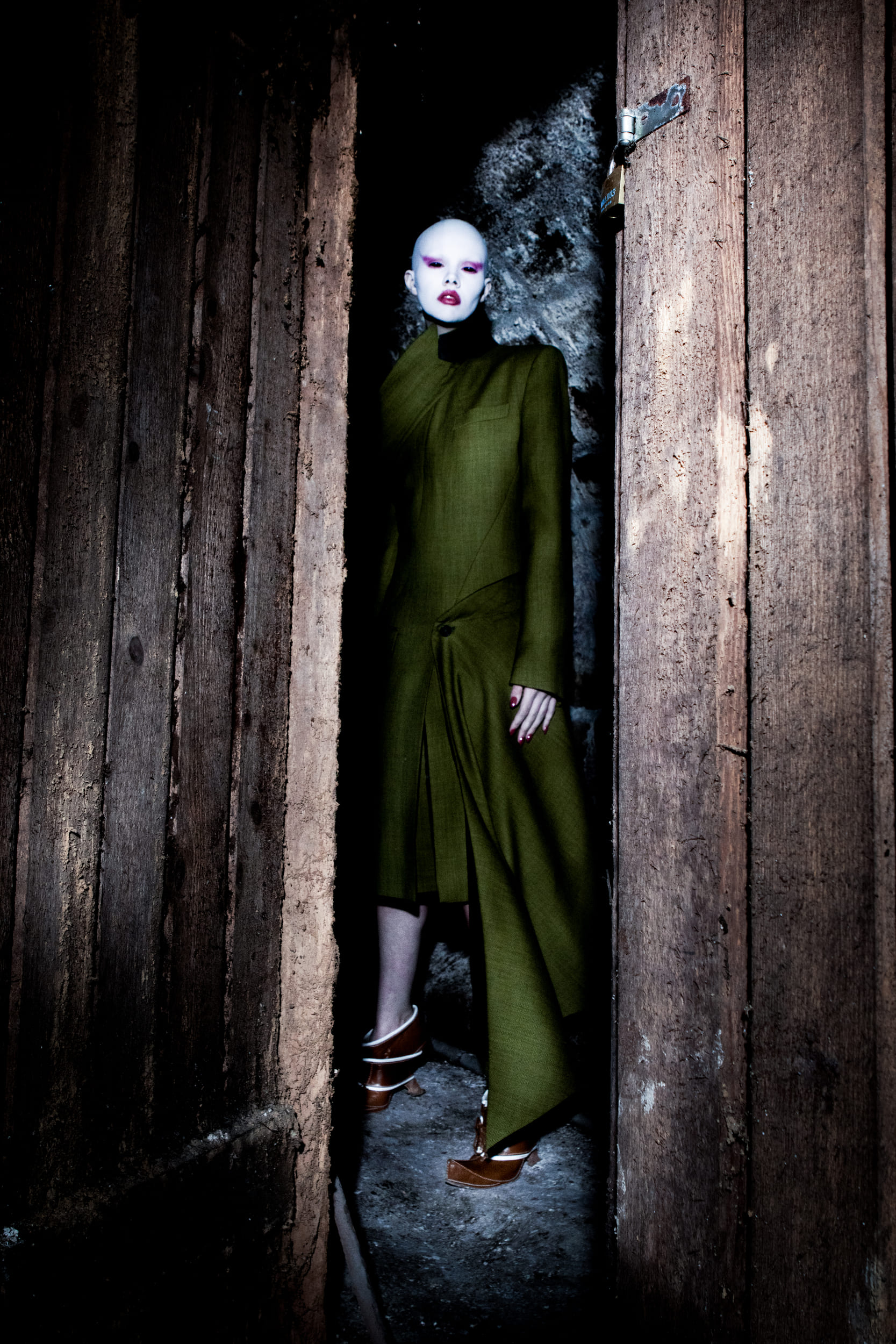
Hannah Rose Dalton in Alexander McQueen It’s a Merry Go Round AW 2001
Best In Show
As objects in and of themselves the masks have a history, but they take on a life when they are used in any kind of performative way, particularly within the context of a fashion show that then becomes iconic. And because culture has shifted, and those early shows of Lee’s have been reevaluated and reassessed and seen for being groundbreaking in lots of ways, the masks have become particularly iconic, some would say.
I’d like to think that the masks and the beaded headdress that I made for Kristen McMenemy and the piece with a skeleton hand enriched the show, visually. And I think what was iconic about the crucifix masks is that they looked great in photos. They look fantastic. They’re a very stark, striking, simple image. And they carry a degree of outrage, which of course, Lee loved, because the figure of Jesus had been removed from a crucifix and used on a mask in the context of a fashion show. So, depending on where you’re coming from and your belief system, this can either be quite blasphemous on one level, or celebratory. It depends on your how you interpret those things.
Wonder And Magic
The person who buys this mask will be owning quite an important part of fashion history. I think, because I deal with curation now, I’ve learned far more about the power of objects, and the way in which they’re interpreted. And the way in which they represent a moment in time. So, I think whoever purchases these will be embracing all of those things. And I hope that the way in which they interpret it and show it will acknowledge those things as well. But when you have a material object, they go on through history, and they keep being reinterpreted. So, an object that could be seen now, in 50 years’ time may be viewed in a completely different way. We have no idea who else is going to be wearing it, or what context it’s going to be in, and people will look back at Lee like Witkin as the artist. And that’s the wonder and the magic I think of, of objects.
Lasting Memories
Reading my early diaries from the time, you know that after that show we were the one’s clearing up, Katie was packing all the garments into boxes and Lee had to give me a hand to pack up. He’d say ‘great thanks’ Simona, as he used to call me. And then we went to the pub, and then his ex turned up, they had a row and he left.
My memories of him are very prosaic, you know, they’re very mundane because he was just a really good mate at the time.
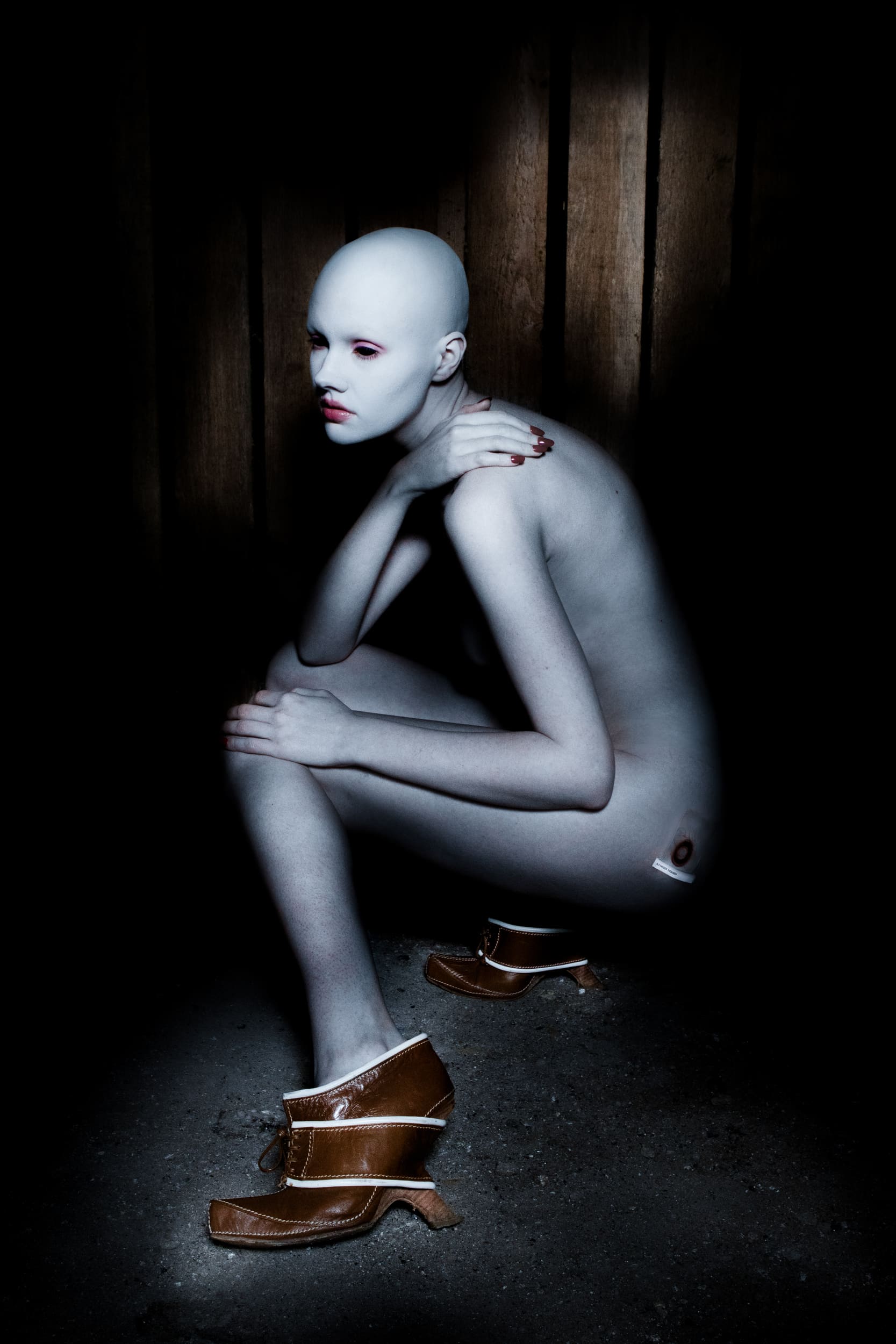
Hannah Rose Dalton in Alexander McQueen No. 13 SS 1999
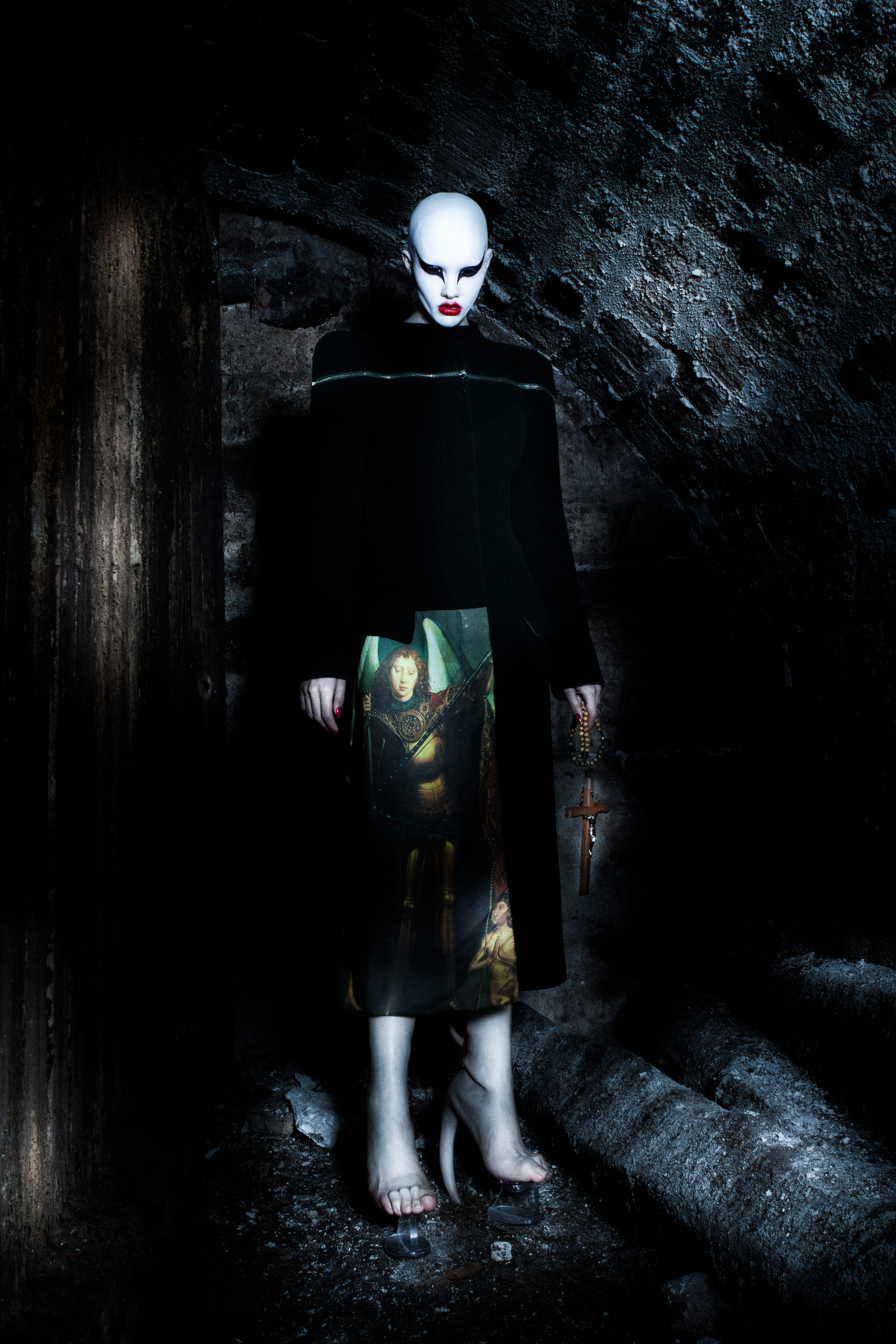
Hannah Rose Dalton in Alexander McQueen It’s a Jungle out There AW 1997